Commyt
Founder, Product Lead & Designer — AI Job Search Companion for LinkedIn
Role & Setup
I founded Commyt. I designed it. I shipped it.
Commyt is not client work. It's a product I conceived, validated, designed, and brought to market as solo founder. The build model: me as Product + Design lead, paired with AI as my engineering and prototyping partner across every phase.
My Role
Founder, Product Lead & Designer
Vision, product strategy, end-to-end UX/UI across web app, Chrome Extension, landing page, and pricing model.
Build Model
Solo founder × AI engineering pair
I drove every product decision; AI tools (Cursor, Claude, Gemini, v0) accelerated implementation, scaffolding, and the feedback loop.
What I Owned
- Problem framing & positioning
- Feature prioritization & roadmap
- End-to-end UX, UI, design system
- Chrome Extension UX
- AI prompt design (scoring, CV tailoring)
- Outreach template structure & messaging
- Pricing model & free/Pro split
- Bilingual EN/ES system
- Launch & measurement plan
Honest scope note: I made the product and design decisions, while AI development tools supported implementation. Google Gemini powers CV tailoring; outreach uses structured, editable templates rather than a second LLM integration.
The Why
Built because the existing tools were working against people
I watched too many brilliant people lose their spark during a job search — not because they weren't ready, but because the process became fragmented. Spreadsheets became difficult to maintain as applications grew. Generic messages took time to personalize. Opportunities, contacts, and follow-ups lived across too many tabs.
Commyt is the product I wished existed when I was applying: one-click capture, AI-tailored CVs, honest match scoring. The boring parts compressed. The human parts protected.
Research & Early Feedback
Fourteen conversations, six hands-on product users
I spoke with 14 job seekers during discovery and early product feedback. Six used the launched product and shared hands-on feedback. I combined those conversations with early sign-up and usage behavior to identify the most important gaps.
Discovery
14 job seekers
Conversations helped me understand how people tracked opportunities, evaluated fit, tailored applications, and managed follow-ups.
Hands-on Feedback
6 product users
Six people used the launched experience and shared direct feedback about the workflow, access constraints, and the types of opportunities they needed to manage.
Overview
What Commyt does
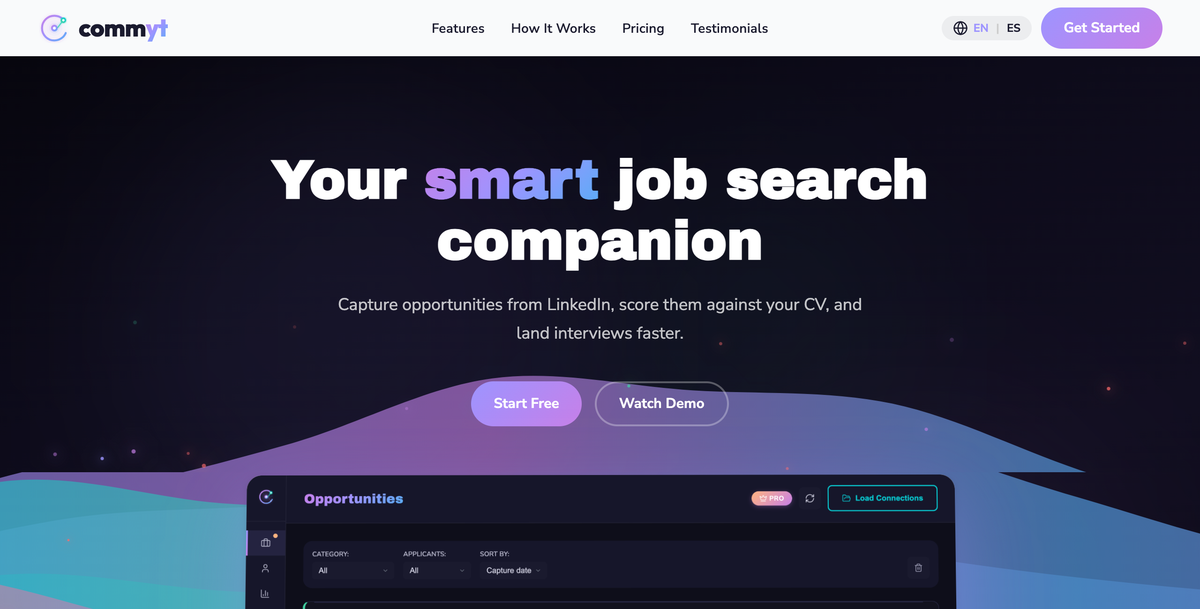
Commyt captures opportunities directly from LinkedIn, scores every job against your CV, and helps you draft personalized outreach. A web dashboard supports the deeper work, a Chrome Extension captures opportunities in the moment, and Google Gemini helps tailor a CV to a selected role.
The Product
Nine features, one focused mission
Every feature in Commyt exists to remove a specific friction in the job-search ritual — or to protect the parts that should stay human. Below: the problem each one solves, the design solution I shipped, and why it works.
One-Click LinkedIn Capture (Chrome Extension)
ProblemCopying job links and details into a spreadsheet adds friction at the moment someone wants to save an opportunity.
SolutionSave any LinkedIn job in one click. Job details, company info, and visible contacts are auto-extracted instantly.
WhyFriction has to die at the moment of intent — not five tabs later in another app.
CV-Based Match Scoring
ProblemApplying to everything that vaguely fits is exhausting and reads as desperate.
SolutionUpload your CV once; every captured job gets a fit % with breakdown by skills, experience, and preferences.
WhyPrioritization should be a glance, not a debate. The score makes the decision a 2-second call.
Personalized Outreach Templates
ProblemCold InMails and connection requests get ignored because they're generic.
SolutionCommyt creates an editable starting point using the role, company, and selected template. The person reviews and adapts it before sending.
WhyA structured starting point reduces drafting effort while keeping specificity, judgment, and voice with the user.
AI CV Tailoring (Gemini)
Problem"Tailor your CV to every job" is the advice everyone gives and nobody follows — it's too slow.
SolutionGemini generates a tailored CV per role in seconds, matching your real experience to the JD. You review and ship.
WhyReducing the time required to tailor a CV makes it easier to review each application intentionally.
Skill Gap Analysis
ProblemRejections don't tell you why. Users guess what's missing and spiral.
SolutionScoring engine surfaces missing skills per role + actionable recommendations to close the gap.
WhyTurns a "no" into a learning loop — and gives users a roadmap they actually trust.
Find Key Connections
ProblemRelevant professional connections can be difficult to identify while reviewing an opportunity.
SolutionSurface your contacts within target companies, filter by relationship strength, suggest the highest-leverage intro path.
WhyReframes networking from "ask for help" to "find the right person fast."
Kanban Pipeline
ProblemA spreadsheet becomes harder to scan as applications move through different stages.
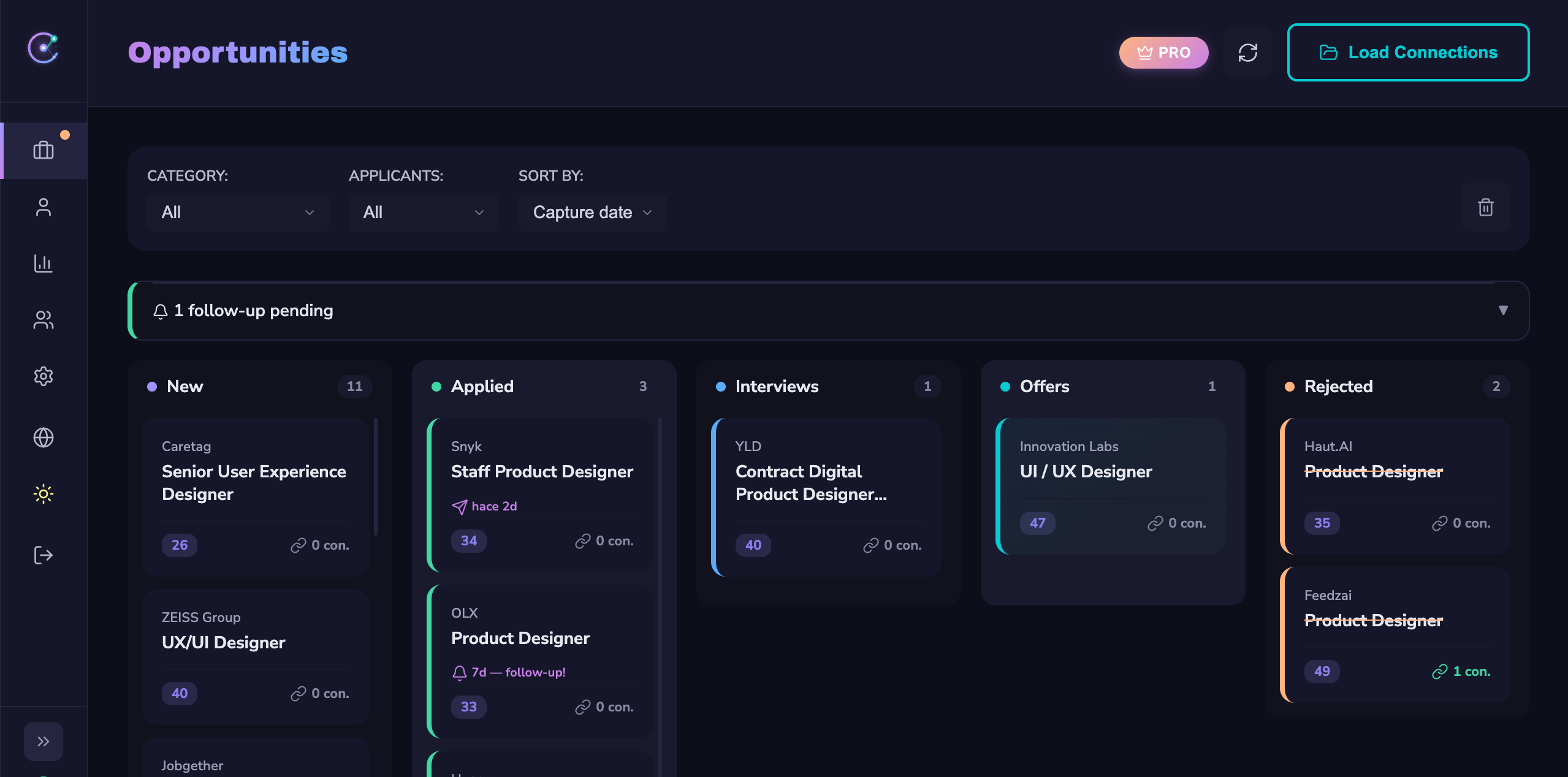
SolutionVisual Kanban: Saved → Applied → Interview → Offer. Drag, drop, see the whole pipeline in one screen.
WhyStatus changes are exactly when you most need the bird's-eye view — the linear table format hides it.
Smart Reminders
ProblemFollow-up actions can be forgotten between "applied" and the next documented step.
SolutionTimed nudges based on application stage and last activity — surfaced inside the app, not lost in email.
WhyKeeping the next action visible helps people manage the process more deliberately.
Activity Heatmap
ProblemJob search is demoralizing. Seeing zero output makes you think you're not trying.
SolutionA GitHub-style heatmap visualizes consistency over time — small actions add up to a visible streak.
WhyVisible activity can make effort easier to recognize during a process where progress often feels unclear.
In Context
The dashboard at a glance
One screen ties together capture, scoring, the kanban, AI tools, and reminders — collapsible sidebar, borderless cards, glanceable AI score badges per row.
Product Decisions & Tradeoffs
Three product calls where the obvious answer was wrong
Every founder decision is a tradeoff. Here are three places where the easy answer would have hurt the product, and the rationale for what I shipped instead.
Where should the free / paid wall live?
Option A
7-day free trial, then card required
Standard SaaS playbook. But predatory for job seekers who are often without income.
Option B
Hard wall after 20 applications
Forces an upgrade at exactly the moment the user has the most momentum and risks making the experience feel punitive.
Chosen · C
Free with meaningful limits
20 apps, 2 AI CV tailorings per month, 3 outreach drafts, and basic scoring. Pro expands the advanced tools.
Why C: The Free tier needs to provide meaningful value through capture, kanban, and basic scoring. The Pro tier expands advanced support without blocking someone before they understand the core workflow.
How structured should outreach support be?
Option A
Fully generated outreach
Fast to produce, but harder for the user to understand, control, and keep consistent with their own voice.
Option B
One generic message
Easy to maintain, but too broad to support different outreach contexts.
Chosen · C
Contextual templates, always user-edited
A structured draft uses the selected context while leaving the final wording and decision with the user.
Why C: The template is a starting point, not the author. Review before sending preserves voice, accountability, and user control.
How transparent should the AI scoring be?
Option A
Just a number (e.g., "74")
Compact, but cold. Users don't trust what they don't understand — and can't act on it.
Option B
Full breakdown always visible
Maximum transparency, but kills row density — the table drops from 12 visible jobs to 5.
Chosen · C
Color badge + score, breakdown on demand
Glanceable up front; click for skills/experience/preferences breakdown. Auditable but not noisy.
Why C: Trust in AI requires auditability, not opacity. Users need to be able to ask "why is this a 74?" and get an answer in one click — otherwise they ignore the score and the feature dies.
Status & Measurement
What the launch taught me
Commyt is live in production. I tested two acquisition approaches on LinkedIn and approximately ten people signed up, but use did not become recurrent. I treat this as an early learning signal, not traction.
Learning 01
Mobile interest, desktop dependency
Some people arrived on mobile but could not continue into the desktop-dependent core experience. The next test is a clear continuation path between devices.
Learning 02
The opportunity source was too narrow
Some people wanted to manage freelance opportunities outside the LinkedIn-centered workflow. The next test is support for manual links and more flexible opportunity sources.
What I Would Measure Next
Evidence before more features
- ActivationNew users who save and begin managing their first opportunity
- ContinueMobile visitors who successfully continue the core experience on desktop
- SourcesOpportunities added from LinkedIn, manual links, and freelance platforms
- AI reviewUsers who review or edit a tailored CV before downloading it
- RetentionUsers who return to manage a second opportunity
Founder Note
Why I'm building this in the open
I watched too many brilliant people lose their spark during a job search — not because they weren't ready, but because their tools were working against them. Commyt is the tool I wished existed: one-click capture, AI-tailored CVs, honest match scoring. The boring parts compressed. The human parts protected.
AI-Enhanced Workflow
How AI let one founder ship a full product
The premise
Commyt would not exist as a solo project five years ago. AI didn't replace the design or product thinking — it removed the friction that used to make founder-led products require a five-person team. I made every product call. AI executed the boring middle.
Discovery & Validation
Helped organize notes from 14 discovery and early-feedback conversations into themes.
Led all 14 conversations, gathered hands-on feedback from six product users, protected nuance, and decided what to build next.
Product Design & UI
Generated dashboard layout variants, palette options, microcopy alternatives.
Every taste call: final palette, type, component anatomy, micro-interactions, brand voice. AI proposed, I disposed.
Engineering & Build
Supported implementation of the web app, Chrome Extension, Gemini CV tailoring, and interface styling.
Made the architecture and product decisions, designed prompts for CV tailoring, defined outreach templates, resolved UX details, and reviewed shipped features.
Launch & Iteration
Drafted landing-copy variants, supported demo-video production, and helped organize early feedback notes.
Pricing model, positioning, landing page direction, prioritized which user feedback becomes a roadmap item.